Ever read a message, tweet, or comment and felt confused by words like because, although, or while? These small words quietly control meaning in sentences—and they’re called subordinating conjunctions.
Understanding the subordinating conjunction meaning helps you read, write, and even text more clearly.
Whether you’re chatting online, writing captions, or improving your English, this guide breaks it down in the simplest way possible.
What Does Subordinating Conjunction Mean?
Subordinating Conjunction Meaning (Simple Definition)
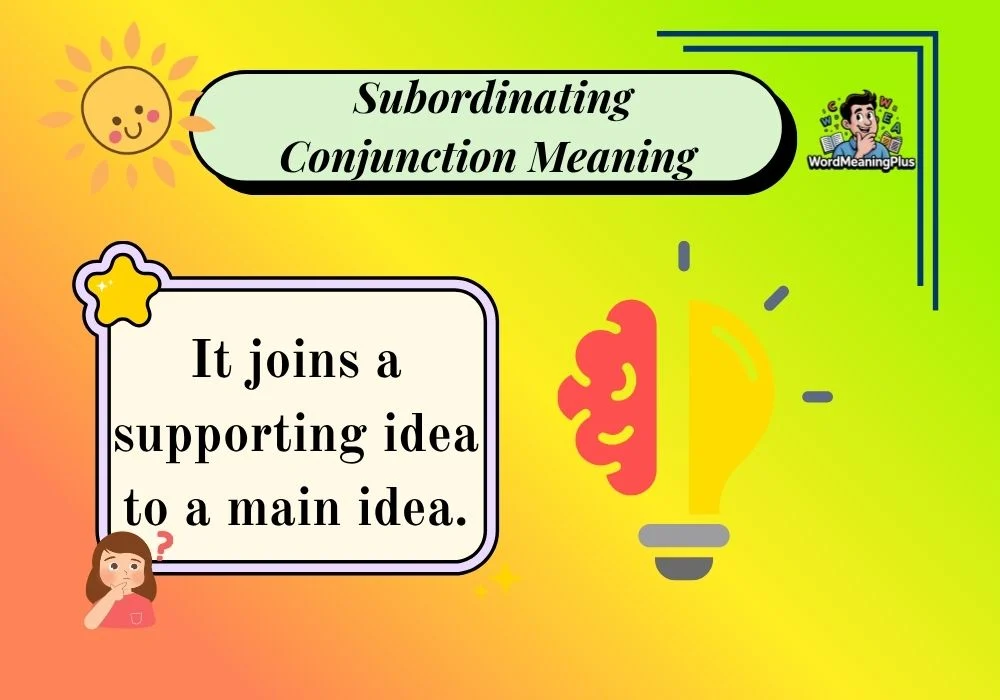
A subordinating conjunction is a word that connects a dependent clause to an independent clause.
In plain English
It joins a supporting idea to a main idea.
Example:
I stayed home because it was raining.
- Main idea: I stayed home
- Extra reason: because it was raining
The word because is the subordinating conjunction.
Where Did Subordinating Conjunctions Come From?
Subordinating conjunctions come from formal grammar, not slang—but they’re used everywhere, including:
- Text messages
- Social media captions
- Emails
- Online comments
- School and work writing
Even modern chat relies on them more than people realize.
Why Subordinating Conjunctions Matter in Texting & Online Chat
You may not notice it, but these words help you:
- Explain reasons
- Show contrast
- Describe time
- Express conditions
Without them, messages sound robotic or unclear. Text without subordinating conjunction:
I didn’t reply. I was busy.
Better text:
I didn’t reply because I was busy.
Small word. Big difference.
Common Subordinating Conjunctions
Here are the most used subordinating conjunctions you’ll see in chats and writing:
Time-Related
- when – at the time something happens
- while – during the same time
- before – earlier than
- after – later than
Example:
Text me when you get home.
Reason & Cause
- because – gives a reason
- since – reason or time-based
- as – reason or timing
📌 Example:
I left early because I felt tired.
Contrast
- although – shows contrast
- though – informal contrast
- whereas – formal contrast
Example:
I like texting, although I prefer calls.
Condition
- if – possible condition
- unless – negative condition
- even if – strong condition
Example:
I’ll go if you come with me.
How to Use Subordinating Conjunctions in Texts or Chat
Subordinating conjunctions are natural in everyday messaging.
Casual Chat Usage
- Keep sentences short
- Don’t overthink grammar
- Focus on clarity
Example:
I didn’t join the call because my phone died
Social Media Captions
Still smiling although today was rough.
✅ Online Forums & Comments
This update helps because it fixes the bug.
Real-Life Conversation Examples (Relatable & Modern)
Example 1: Friends Chat
I stayed offline since my internet was down.
Example 2: Work Message
I’ll finish it today if nothing urgent comes up.
Example 3: Family Group Chat
We ate late because dad came home late
Common Mistakes & Misunderstandings
Even fluent speakers mess these up.
Mistake 1: Sentence Fragment
Because I was tired.
Correct:
I slept early because I was tired.
Mistake 2: Wrong Word Choice
I stayed home although it was raining.
(That sounds wrong because although shows contrast.)
Correct:
I stayed home because it was raining.
Mistake 3: Overusing One Word
Using because in every sentence makes writing boring.
Mix it up with:
- since
- although
- while
- if
Subordinating Conjunctions vs Coordinating Conjunctions
Many people confuse them.
Quick Comparison
| Type | Purpose | Examples |
|---|---|---|
| Subordinating | Connects main + extra idea | because, although |
| Coordinating | Connects equal ideas | and, but, so |
Example:
I wanted to go, but it was late. (coordinating)
I didn’t go because it was late. (subordinating)
Related Grammar Terms You Should Know
If you’re learning meanings, these are helpful:
- Dependent clause
- Independent clause
- Conjunction
- Sentence connector
- Complex sentence
📎 Internal linking suggestion:
Link this article to guides like:
- Dependent Clause Meaning
- Coordinating Conjunctions Explained
- Text Grammar Rules for Beginners
Where Subordinating Conjunctions Are Commonly Used
You’ll see them everywhere:
- WhatsApp & Messenger chats
- Instagram captions
- TikTok comments
- Reddit threads
- Emails & work messages
- AI-generated content (yes, even bots )
They are timeless, not outdated.
Personal Insight: Why This Matters More Than You Think
As someone who studies modern communication, I’ve noticed this:
People who use subordinating conjunctions well sound clearer, smarter, and more confident—even in casual texts.
You don’t need perfect grammar.
You just need the right connector at the right time.
Quick Cheat Sheet (Save This)
- because → reason
- although → contrast
- if → condition
- when → time
- while → overlap
Final Thoughts:
To sum it up, the subordinating conjunction meaning is simple:
It connects an extra idea to a main idea and explains why, when, or under what condition something happens.
Once you understand this, your texts, comments, and writing instantly become clearer and more natural. And the best part? You’re probably already using these words—you just didn’t know their name.
Updated for 2026, this guide helps you stay confident in modern communication without sounding stiff or outdated.

Anderson is a passionate writer and language enthusiast who loves exploring the meanings of words, modern slang, and internet abbreviations. As the author of WordMeaningPlus.com, Anderson’s goal is to help readers understand the true meaning of words, phrases, and texting slang in simple and easy English.
With a strong interest in language, communication, and online trends, Anderson writes informative articles that explain word meanings, chat abbreviations, and social media slang in a way that is clear, helpful, and easy to understand. The main mission of WordMeaningPlus.com is to make language learning simple for everyone, especially students, bloggers, and internet users who want quick and accurate meanings.